Written By Chris Remboldt
It's hard to believe it's only been five months since Adam Faragalli and I officially incorporated AgentWorks back in July.
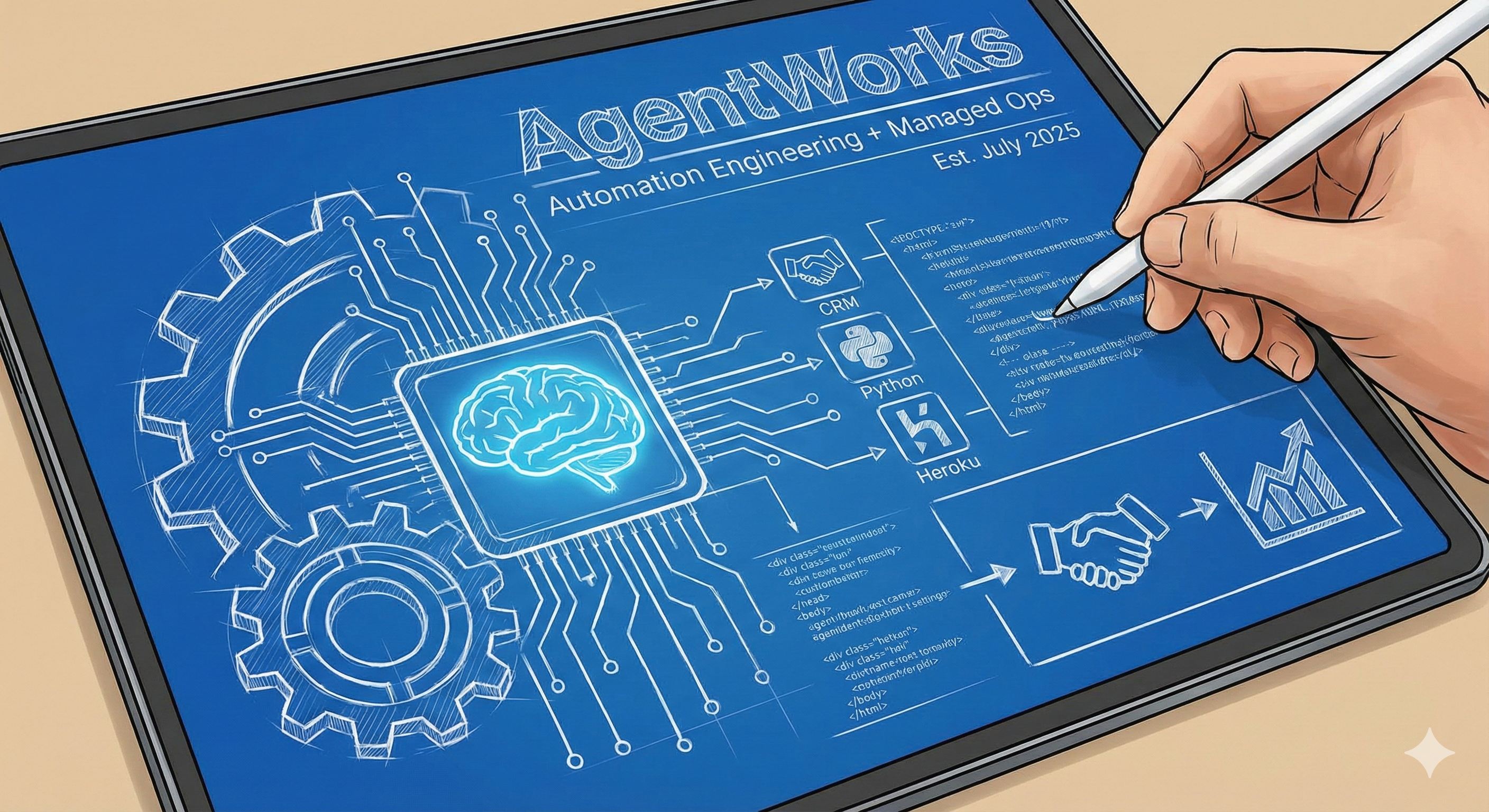
When we started, the hypothesis was simple: local businesses didn't need more software; they needed their software to actually talk to each other. We saw a world full of "AI Agencies" promising magic chatbots, but we wanted to build something different—an automation engineering firm that treats business workflows like mission-critical infrastructure.
We've spent the last half-year in the trenches with roofing companies, gutter installers, and garage door experts. We've written thousands of lines of Python, deployed countless Heroku dynos, and pushed GoHighLevel (GHL) to its absolute limits.
Here is what we have learned along the way.
1. The "Last Mile" is 95% of the Work
Everyone talks about the "AI revolution," but the reality on the ground is much grittier. We learned fast that a 90% solution is a 0% solution for a business owner.
If a lead comes in from Facebook and the automation fails because of a browser quirk in Safari or a "completedUnknown" call status, that business loses money. We realized that our value wasn't just in the "cool AI" parts, but in the unsexy, custom middleware we build to handle the messy edge cases that standard platforms ignore.
2. It's Not Just a Product, It's a Service
We started with the idea of building tools, but we quickly pivoted to "Managed Operations."
You can't just hand a complex automation system to a busy sales team and walk away. Real-world workflows change. Employees click the wrong buttons. APIs break. We learned that to build trust, we had to be there to monitor the systems, fix the data leaks, and constantly refine the logic. That's why we've built out a support structure (and hired some amazing VAs) to make sure our clients feel like they have an entire engineering department in their corner.
3. Platform Constraints are Opportunities
We've hit every wall you can imagine—from Zapier trigger limitations to GHL's occasional confusion over which "opportunity" to update when a client has three active projects.
But these headaches have become our moat. Because we write our own code (mostly Python and Flask) to bridge these gaps, we can offer reliability that a standard drag-and-drop agency simply can't match.
What's Next?
The last five months have been a blur of building, debugging, and scaling. But we aren't slowing down.
We have been quietly testing a hypothesis in a completely different area, and we are deep in the lab working on an exciting new vertical that we'll be announcing very soon. It takes everything we've learned about automation engineering and applies it to a problem set that is desperate for this kind of rigorous, systems-thinking approach.
Stay tuned. 2026 is going to be fun.
Update — April 2, 2026
I have decided to leave AgentWorks. With Adam and a talented new technical addition to the team, Will, the company is better positioned than ever to serve its clients—legendary technical skill and customer service in one place. I have no doubt they will keep pushing the industry forward in ways that still don't have any peer.
For me, the time has come to start building in the drone space. It's something I have known was coming for years, and that future is now. I genuinely loved working with every client we brought on, and I'm proud of what we built together. Onward.
— Chris Remboldt, April 2, 2026
Website: https://youragentworks.com
X: @chrisremboldt
Email: [email protected]
Want to work together? Get in touch to discuss your automation needs.