Written By Chris Remboldt
If you're here reading this and you're building something in the drone world—or you're thinking about it—then we need to have a quick chat. Something is about to happen to the industry you work in, and depending on how you prepare for it, it's either going to be the best thing that ever happened to you, or it's going to quietly ground a lot of really promising companies on the runway. I'd like to help you land on the good side of that.
Let me walk you through what's going on, why I think it matters way more than most people realize, and what I'm building about it.
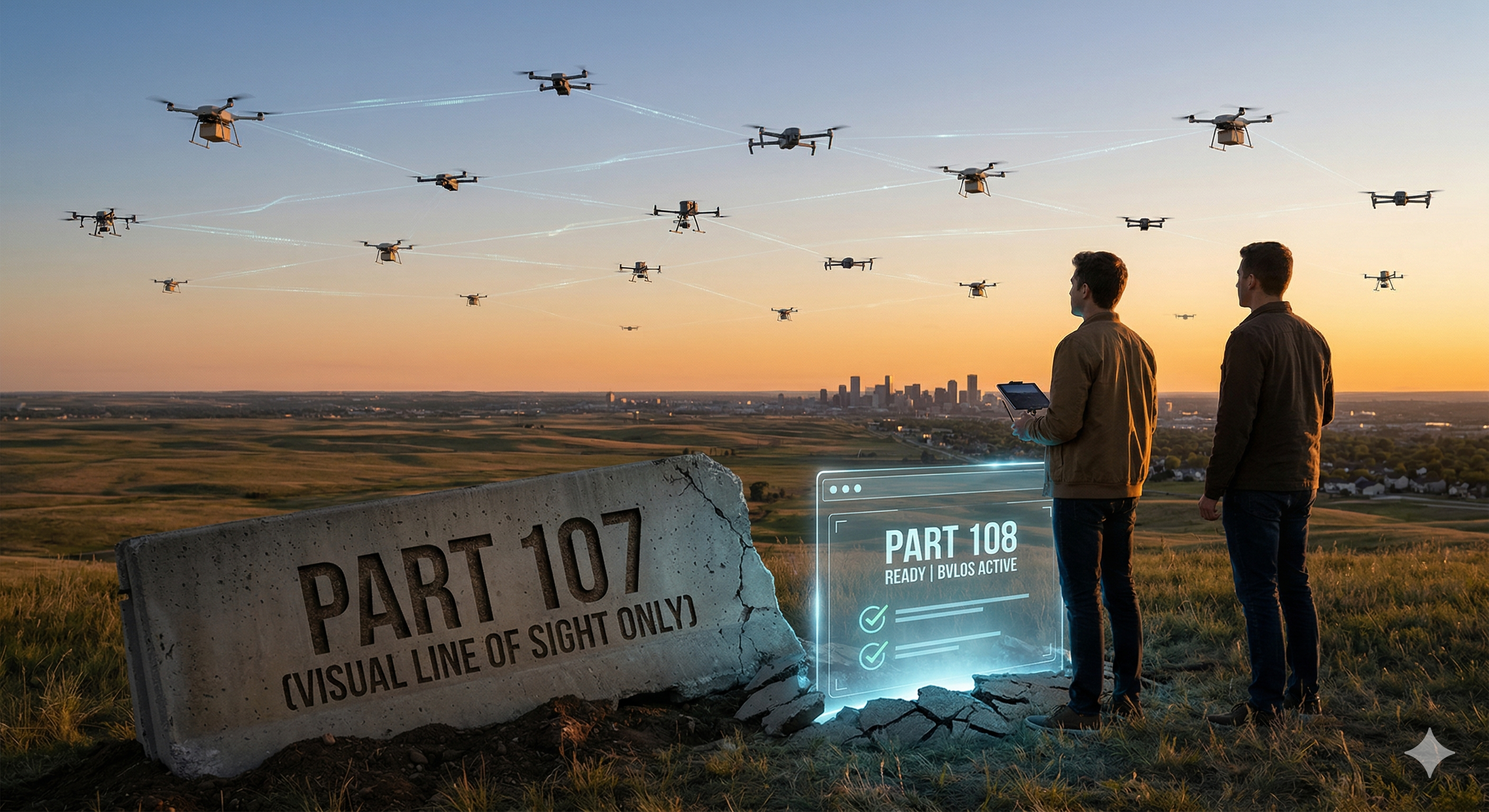
Let's take it from the top. Right now, almost everyone flying drones commercially in the United States is flying under Part 107. That's the rule the FAA put out back in 2016, and at the time it was a huge deal—it's the reason there's a commercial drone industry at all. But Part 107 has a pretty significant catch baked into it: with very few exceptions, you have to keep your drone within your own line of sight. You, the human, have to be standing there watching it.
That single constraint is the reason drone work is the size it is today instead of the size it should be. If a human has to stand in a field and watch each flight, then the economics of everything—delivery, inspection, agriculture, mapping, search and rescue, you name it—are capped by how much you have to pay that human. It means a lot of work that drones could absolutely be doing today just doesn't pencil out. Entire business models that should exist simply don't, because the ceiling is too low.
The unlock for all of this is called Beyond Visual Line of Sight, or BVLOS. The name is exactly what it sounds like—the drone goes past where you can see it, and keeps doing its job. This is not a small upgrade. This is the difference between "a pilot babysits one drone for one flight" and "one operator supervises a whole fleet covering a whole county." It's the difference between a novelty and actual infrastructure. I'd argue the value unlock here is not 2x or 5x, it's more like 100x, and it's the hinge the entire drone industry has been waiting on for nearly a decade. BVLOS is the moment drones stop being a cool tool and start being a new category of infrastructure, on par with trucking or the early internet.
And here's the wild part—it's basically here. The FAA dropped a proposed rule called Part 108 in August of 2025, which is designed to make routine BVLOS operations legal at scale. If you've been in the drone world for any amount of time, you know this rule has been the subject of approximately one million blog posts, waiver workarounds, and wishful thinking. The comment period closed in October, the FAA is working through revisions, and a final rule is expected in 2026. This is really happening.
So that's the good news. Now for the part that's been bothering me.
When Part 108 finally dropped, a lot of us in the industry read it and our hearts kind of sank. The proposal is over 700 pages long, and the requirements it wants to put on operators are, to put it gently, large. We're talking full safety management systems, certificated personnel, organizational-level approvals, detailed recordkeeping, new required roles like Flight Coordinators and Operations Supervisors, and a whole stack of documentation that looks a lot more like what you'd expect from a regional airline than from a team of founders trying to get a drone company off the ground.
And I'm not the only one who noticed. The FAA got over 3,000 public comments on this proposal, and the consistent refrain from the industry was not "don't do this"—everyone wants BVLOS—but "please don't do it this way." Pilot Institute, which has trained hundreds of thousands of drone pilots, wrote a 28-page comment warning that the rules would eliminate pathways for thousands of current operators while favoring large, well-funded companies over new entrants. AUVSI, which is basically the industry's biggest trade association and generally very pro-FAA, raised concerns that emerging operators may face significant challenges in meeting certain requirements. Even MassDOT—a state government agency, not some scrappy bootstrapped startup—told the FAA the rule would create a dramatic increase in administrative burden and cost, and asked for some kind of middle road.
When Pilot Institute, AUVSI, state DOTs, and a bunch of law firms all independently point at the same problem, you should probably pay attention. The problem is this: the rule as written expects a drone company to spend most of its early energy building a compliance department instead of building a drone company. It just isn't realistic, and the people writing the comments know it.
This is the part that really frustrates me. The same country that is (rightly) worried about losing ground to overseas drone manufacturers and overseas drone operators is about to make it dramatically harder for Americans to start drone companies at exactly the moment the industry is supposed to break open. We are on the verge of accidentally gatekeeping our own industry, right when it was finally going to get interesting. And the effect of that gatekeeping isn't just "a few small guys get squeezed out"—it's that the entire pipeline of new entrants slows to a trickle, which is the absolute worst thing that could happen to an industry that's supposed to be exploding into ten new verticals at once.
Because let's be honest about what's on the table. If Part 108 works the way it could work, we are about to see an entire generation of new drone companies: medical delivery, last-mile logistics, precision agriculture, autonomous inspection, wildfire detection, drone-as-first-responder, linear infrastructure patrol, rural package delivery, site security, and probably five more verticals that nobody's thought of yet. These companies will create enormous amounts of value. They will save lives. They will lower the cost of living for people who currently pay way too much for goods and services because they live too far from a city. This is the kind of generational opportunity that only comes around once or twice a decade, and it's a tragedy if the regulatory framework around it accidentally ensures that only incumbents get to play.
And the thing is, it's not that the compliance burden is wrong in principle. Flying big autonomous aircraft around populated areas is a serious thing and it should be taken seriously. The burden has to exist. The question is whether founders can carry that burden without hiring a compliance department they can't afford and don't want. Because if they can carry it with software, then a founding team can stay focused on what they're actually good at—building a drone company that flies drones and makes money doing it—instead of spending half their runway on paperwork.
So let me tell you what I'm doing about it.
I started a company called Lightcone Systems, and the first product we're building is called Lightcone Ledger. The honest, missionary reason I started it is that I want American drone founders to be able to start drone companies and stay drone companies—not slowly metastasize into compliance companies that happen to fly drones on the side.
Because the prize here is enormous. I'm talking about delivery to rural pharmacies that costs pennies instead of dollars. Wildfire spotting that catches ignitions in the first ten minutes instead of the first hour. Infrastructure inspections that find the bad weld before it kills anybody, and drone-as-first-responder programs that get eyes on an emergency before the first officer arrives on scene. Autonomous ag flights that make food cheaper. Routine medical delivery to places where "routine medical delivery" currently means a two-hour drive. Every one of those things gets cheaper, safer, and more common in a world where drone companies can actually exist at scale. None of them happen if the regulatory burden on starting a drone company is so heavy that only incumbents with legal departments can afford to play.
The way I think about Lightcone Ledger is that it's a system of record for a drone operation. It's the tool I wish existed when I first started seriously reading Part 108 and trying to figure out what an operator would actually have to produce, track, and prove on demand. The mental model we built it around is pretty simple: you record the truth about your operation, the software checks it against the rules, it tells you where you're exposed, and when somebody comes asking for proof, you already have the receipts.
So you record your fleet, your operators, your missions, your flight logs, the configuration of each aircraft at the time of each flight—all the stuff that would matter if a regulator or an insurer asked you to defend a flight. Then the software automatically checks that against Part 107 today, and it also runs a Part 108 shadow mode alongside—so you can see, mission by mission, where you would stand under the proposed Part 108 rule before the final rule even lands. It doesn't pretend the proposed rule is binding law. But it does give you something you otherwise can't buy, which is a head start. The difference between "Part 108 dropped and I'm scrambling" and "Part 108 dropped and I already know my top three gaps and I've been quietly closing them for six months."
When something goes sideways, the system gives you a finding—with a specific regulatory citation attached, not some vague AI hand-wave—and you can track the fix and close it out. And when it's time to actually prove compliance to somebody, the system generates what we call an evidence pack, which is a hashed, human-attested compliance record you can actually hand to a regulator, an insurer, or a customer's legal team.
One thing I want to be really clear about, because the word "AI" is doing a lot of work in the world right now—the pass/fail compliance checks in Lightcone Ledger are deterministic. No large language model is deciding whether your flight was legal. The rules are codified, the engine runs them against the facts, and the output cites the actual regulation. That is not a limitation, that is the entire point. Compliance evidence has to be the kind of thing you can defend in a room full of lawyers, not the kind of thing that might have hallucinated a citation.
The philosophy underneath all of this is that compliance for a drone operation should feel less like hiring a law firm and more like running a good automated test suite. You record what happened, the computer checks it against the rules, you find out where you're exposed, and you fix it. That's it. That's what Part 108 readiness should feel like, and right now it does not feel like that for anybody, because the tooling doesn't exist yet. I'm building the tooling now, because I think the difference between "a handful of incumbents fly BVLOS" and "a thriving ecosystem of hundreds of new drone companies flies BVLOS" is almost entirely a tooling problem.
A few final thoughts I'll leave you with.
The final Part 108 rule is probably going to be heavy no matter what the FAA does with those 3,000 comments. The question isn't whether the burden exists—it's whether founders have the tools to carry the burden without turning their companies into compliance shops. I think they can, I think the software to make that possible is very buildable, and I think the window to build it is right now. If we get this right, the next ten years of American drone entrepreneurship look absolutely wild. If we get it wrong, the whole thing stalls out and the value gets captured overseas or by a handful of incumbents, and that would be a real shame.
I also think this matters way more than drones. The path to a genuinely more abundant future—cheaper goods, safer communities, faster emergency response, lower cost of living—runs through boring infrastructure that nobody claps for. Permitting. Logistics. Compliance tooling. The flashy AI demos get the attention, but the actual wins come when a founding team can suddenly legally do something it couldn't do last year, because the compliance work that used to take six months and a consultant now takes an afternoon and a piece of software. Drones are one of the clearest examples of this pattern I can think of, and Part 108 is where it either happens or it doesn't.
And finally—if you're a founder building in this space, or you're thinking about it, I'd love to talk. I'm building this for you, and the more time I get to spend with actual operators the better the product gets. Part 108 is coming whether we're ready or not. Let's go build the companies that prove it was worth fighting for.
Website: https://lightconesystems.com
X: @chrisremboldt
Want to talk drone compliance or BVLOS readiness? Get in touch.